

Concrete Driveways
What goes into a new Rialto driveway, from the base under it to the finish on top, and what it typically costs.
Typically from $7/sq ft
Concrete driveways · patios · repair · Rialto, CA
Concrete Foothill Rialto is a local guide and availability check for concrete driveways, patios, stamped concrete, walkways, slab repair and business flatwork in Rialto: driveways poured in the 1970s and 1980s that are now cracked and due for tear-out, RV and side-yard pads, gated newer tracts, and lots and aprons near the freeways. See typical prices for your own square footage, see how thick and how reinforced a slab should be, and see whether a local concrete contractor has bookings open for your ZIP yet.
Notify me when bookings open · typical prices in about 30 seconds
Bookings aren't open yet. Leave your name and number; your message is recorded, and you'll get one message when a local installer is available.
 Illustration
AI-generated illustration. The people shown are not real installers.
Ten home pages, one for each decision: which driveway, how a replacement goes, what the street-side strip needs, which finish for a patio and what to do about a crack or a sunken slab.
What goes into a new Rialto driveway, from the base under it to the finish on top, and what it typically costs.
Typically from $7/sq ft

How a tear-out and replacement goes in a Rialto driveway, what comes out first and what it typically costs.
Typically from $8/sq ft

The apron where a driveway crosses the sidewalk and meets the curb, and what the city's published documents say about work there.
Typically from $1,500/job

How stamped and colored concrete is made and kept, and what a stamped patio typically costs.
Typically from $12/sq ft

A heavier slab for an RV, trailer or side-yard access, and what to settle before it is poured.
Typically from $9/sq ft

Planning a Rialto patio slab, from the slope to the finish, and what it typically costs.
Typically from $7/sq ft

Four finishes side by side, and which one suits a hot driveway, a walkway or a patio.
Typically from $8/sq ft

Private walkways and steps, and where the public sidewalk begins.
Typically from $7/sq ft

What can be repaired, what can be covered and what has to be replaced on a cracked or flaking Rialto slab.
Typically from $2/sq ft

Mudjacking, foam and replacement compared for a sunken driveway or walkway slab.
Typically from $4/sq ft

The overview of private commercial flatwork in Rialto and what a typical surface costs.

A private parking surface with its accessible route, who decides the layout and what the concrete typically costs.

What a truck court and a loading apron need underneath and in their joints, and what they typically cost.
Answer a few quick questions, one at a time: a new driveway, patio or walkway, a repair or resurfacing, or a business property, then the size and the details. The total updates as you go and uses the same Rialto area market figures shown on every page of this site.
Takes about 30 seconds · no sign-up to see your range
Check availability and get your Rialto area price range
Bookings aren't open yet — a typical Rialto range in about 30 seconds.
Pick a pattern, a base color and an antiquing color; the strip on the right shows a broom finish and exposed aggregate in the same base color. It is an on-screen approximation; a sample slab shows the real color.
On-screen approximation; ask for a sample slab in the sun.
 Illustration
Typical total $6,550–$12,600
 Illustration
Typical total $2,914–$5,428
 Illustration
Typical total $4,870–$8,680
 Illustration
Typical total $1,590–$3,600
 Illustration
Typical total $8,800–$16,700
 Illustration
Typical total $14,500–$27,800
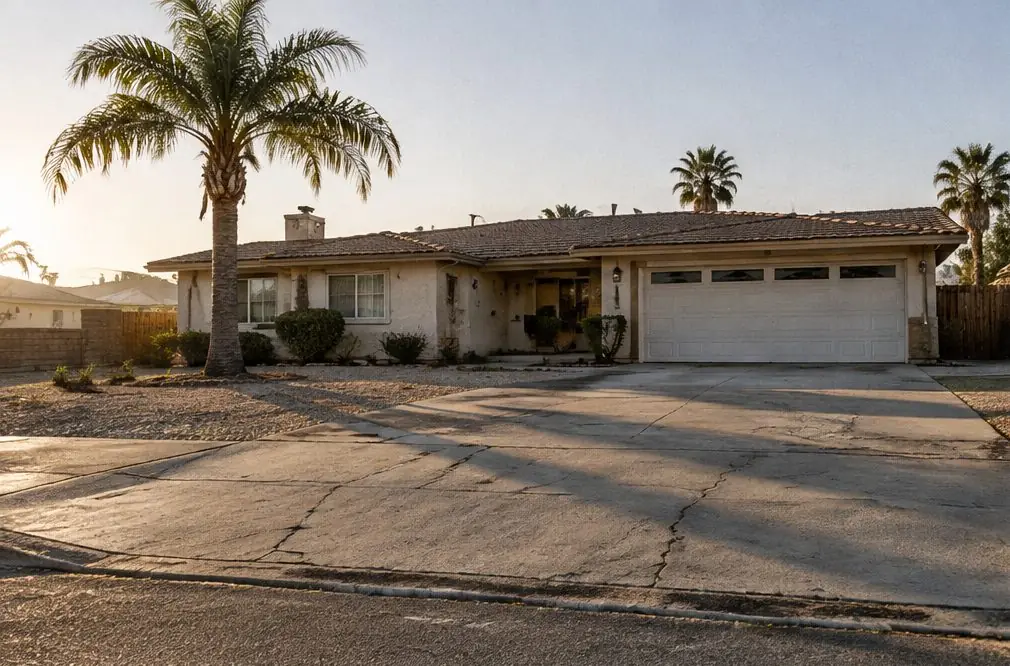
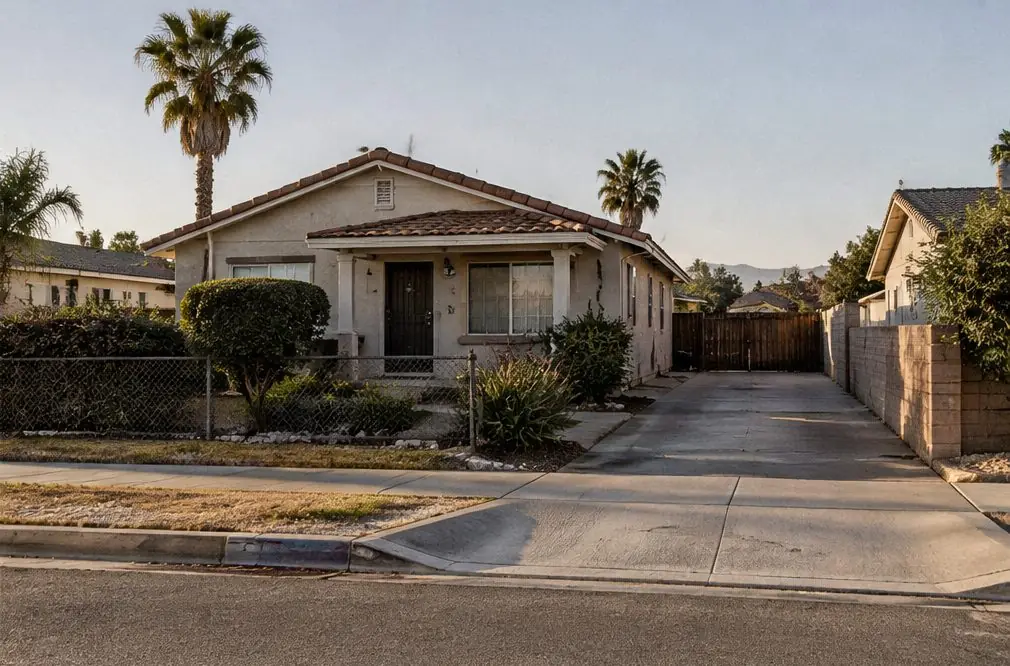
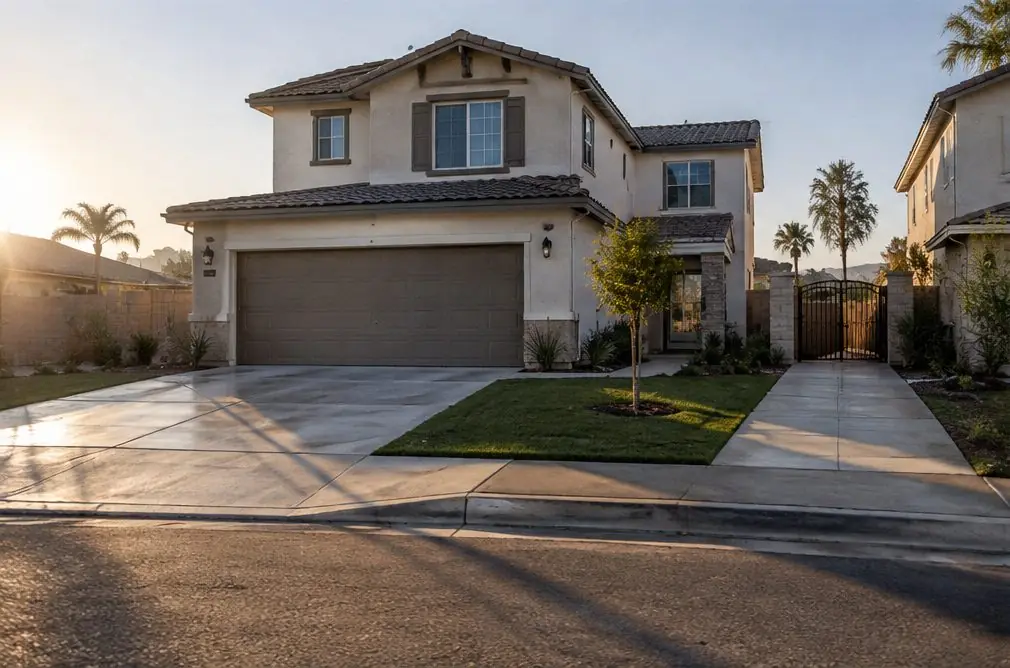
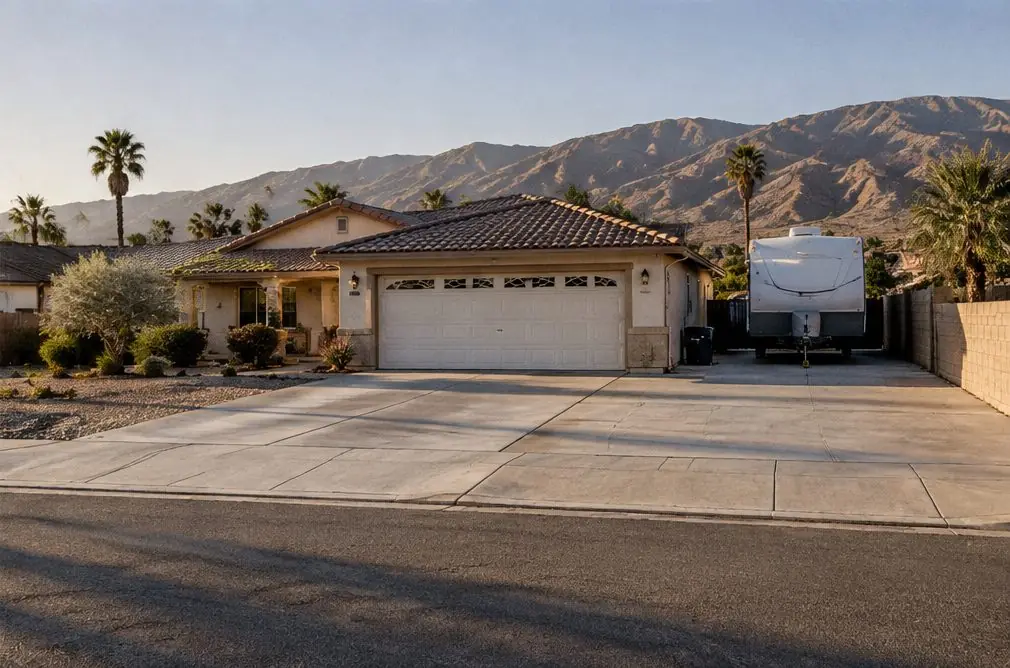
Hypothetical typical projects. Pictures are AI-generated concept illustrations, not photos of completed installations; no installation was performed or arranged through this site; prices are typical Rialto area market ranges, not quotes.
Pick a use to see a typical section. Thickness and reinforcement follow the load, and builders disagree on some of the middle cases; the table says where.
| Use | Typical thickness | Reinforcement often used | Where builders differ |
|---|---|---|---|
| Walkway | 4 in. | Wire mesh or fiber | Some use rebar on long or sloped walks |
| Patio | 4 in. | Wire mesh, fiber or a rebar grid | Mesh must sit in the middle of the slab to help; fiber is a mix additive |
| Car driveway | 4 in.; some choose 5 in. | A rebar grid on chairs | Wire mesh is cheaper and is often laid on the base, where it does little |
| RV, trailer or truck pad | 5–6 in. | A rebar grid on chairs | Closer rebar spacing and thicker edges on the heaviest loads |
A general guide. The plan for the property, the soil as the contractor finds it and the maker's data decide.
A schematic drawn to typical thicknesses; the plan for the property and the contractor decide the real section.
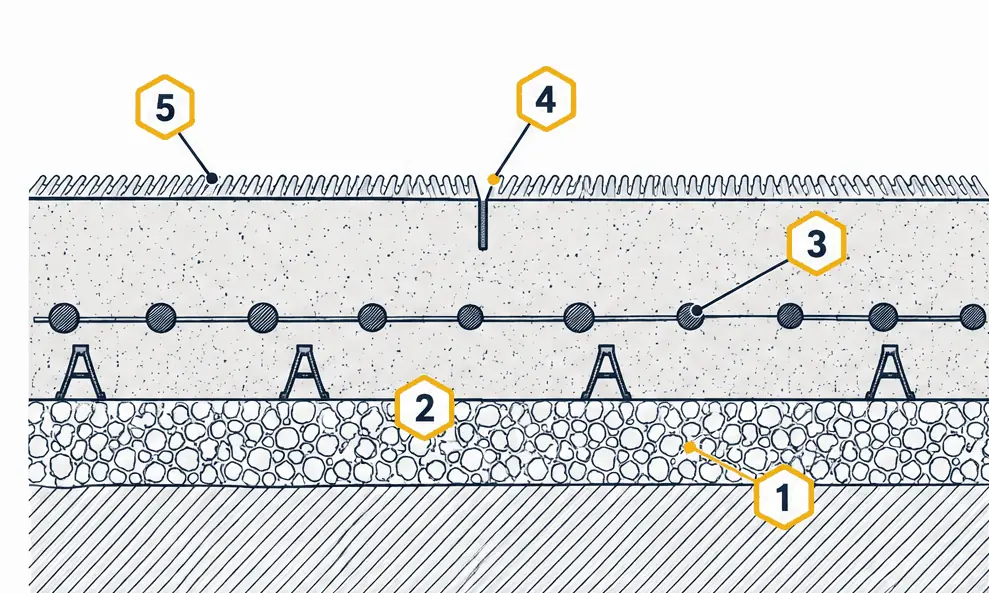
Think of it when you compare quotes and want to know what each layer is for: base, reinforcement, joint and finish.
Typically $7–$10 per sq ft about $4,800–$7,200 for 480 sq ft, installed
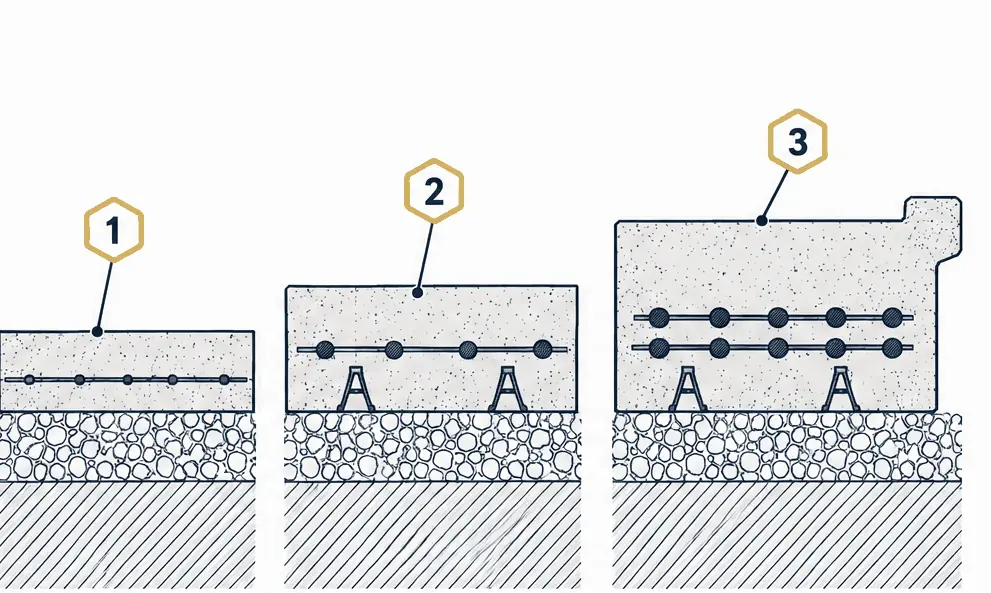
Think of it when you are deciding between a standard slab and a thicker one for an RV, a truck or a heavy gate.
Typically $7–$10 per sq ft about $5,280–$8,160 for 480 sq ft, installed
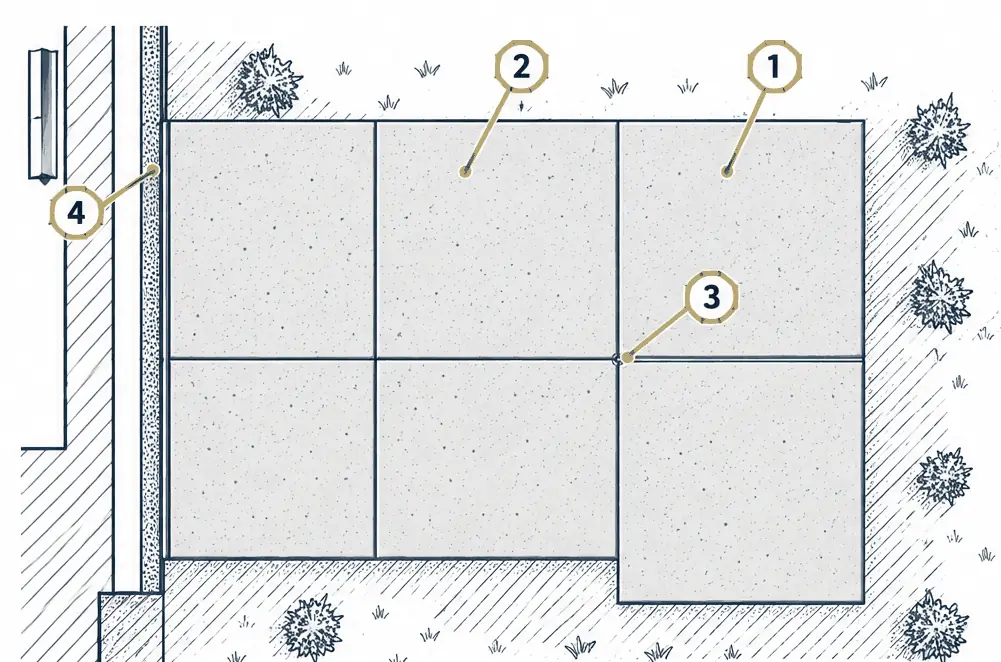
Think of it when you read a quote's joint plan and want to know where a crack is meant to happen.
Typically $7–$10 per sq ft about $4,800–$7,200 for 480 sq ft, installed
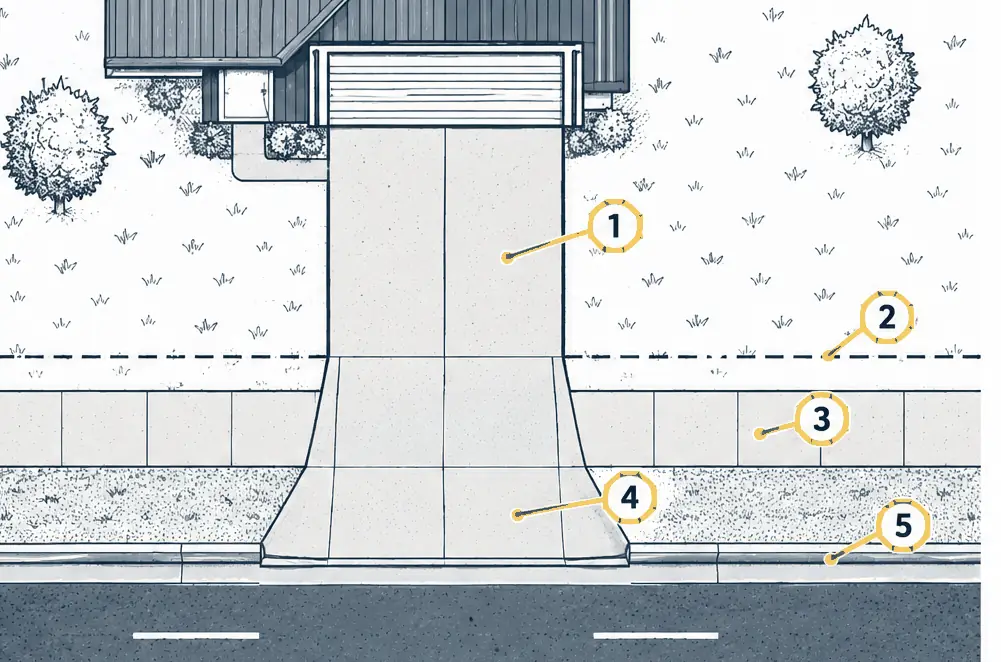
Think of it when a driveway job reaches the street and the city's right-of-way becomes part of the scope.
Typically $7–$10 per sq ft about $6,300–$11,700 for 480 sq ft, installed
Finish choices look like a matter of taste and are really a matter of heat, grip and upkeep. Cost is the Rialto installed range per square foot for a car-driveway slab (4 in. with a rebar grid) from the calculator on this page; the rest is general behavior of the finish, and the contractor's samples and the product data decide.
| Finish | Typical cost | Grip when wet | Heat in the sun | Upkeep and where it tends to cause trouble |
|---|---|---|---|---|
| Broom finish, plain gray | $8–$11.50 per sq ft | Good; the texture adds grip | Lighter colors stay cooler than dark ones | Stains show; hairline cracks happen at the joints |
| Exposed aggregate | $10–$15.50 per sq ft | Good; a rough surface | Moderate; stones hold heat | Loose stones if the surface was not set well; a sealer is a maintenance step |
| Integral color, broom or smooth | $9–$14.50 per sq ft | Depends on the finish; smooth is slicker | Darker colors get hotter underfoot | Color varies from batch to batch; ask for a sample slab |
| Stamped and colored | $13–$20.50 per sq ft | A sealed surface can be slippery when wet; a grip additive helps | Dark colors get hot in direct sun | Sealer needs renewing; color can fade; patterns do not hide settlement |
Cost bands are market estimates, not quotes. Nothing here promises how long a finish lasts or that a slab will never crack; compare the finish, the joints, the reinforcement and the written terms instead.
Most of a driveway is private flatwork. The last few feet, the approach that crosses the sidewalk and meets the curb, sit in the public right-of-way. Rialto Public Works publishes encroachment permit conditions (revised in February 2026) and an application form for work in that strip. This block summarizes what those two documents say and nothing else; the city confirms what applies to a particular address.
| Where the work is | What to know | Who answers |
|---|---|---|
| On the private lot, behind the property line | Many private flatwork jobs need no city encroachment permit, but grading, retaining walls over about 4 feet, structural slabs and drainage changes can need a building permit | The City of Rialto for the address; a licensed contractor |
| The approach, the curb cut or the sidewalk in the right-of-way | Work in the public right-of-way needs an encroachment permit from Public Works, Engineering Services | Public Works, 335 W. Rialto Avenue |
| A tree, a utility line or a slope near the work | The documents call for a utility locate (USA 811) at least 48 hours before any excavation | The permit holder, per the city's conditions |
| A gated or planned community | Exterior concrete is often an architectural-review item; the CC&Rs decide, and some require approval before work starts | The association |
| Bloomington and other unincorporated pockets | Outside city limits, the county rather than the city answers | San Bernardino County |
The application form lists what has to come with a permit request: a current City of Rialto business license, proof of general liability insurance of at least one million dollars that names the City as an additional party, plans of the work, and a traffic control plan. It also asks for the contractor's license number and type. Applications are not accepted unless every item is provided.
The conditions set work hours of 7:00 a.m. to 5:00 p.m., Monday through Friday, ask for 48 hours' notice, require a California-licensed survey for lines and grades in the right-of-way, and say forms and the subgrade must be inspected before material is ordered. They also say a damaged concrete driveway that is one monolithic piece is removed and replaced in its entirety.
On timing the two documents differ: the conditions give 90 calendar days to complete the work and also a validity of six months, and the application form says a standard permit is valid for 180 days. Fees exist and are set by the city; none are quoted here. Ask the city which dates apply.
Pick the pour date and the expected weather. The result is a typical order of waits; the contractor and the mix maker's data set the real days.
Hot weather speeds the set but not the strength: pours start early, the surface is protected and the slab is kept moist for roughly the first week. Cool weather slows the gain in strength, so the waits may be longer.
A typical order, not a promise. The mix, the thickness and the weather decide.
Enter the length, the width and the thickness. The result is a suggested joint grid, the number of panels and the cubic yards to order.
Joints are spaced at about 2.5 ft per inch of thickness, no more than the stated maximum, and laid out to keep panels close to square.
A planning aid, not a drawing for construction. The contractor lays out the joints on site.
Private lots with accessible routes and ramps, poured in phases so the lot stays open.
Thicker, reinforced slabs for trucks, with joints planned for the traffic.
Small, heavy slabs for bins, compressors and generators, sloped and jointed.
Private walks and curbs around a building, away from the public right-of-way.
Check the contractor's license at cslb.ca.gov before signing; work above $1,000 requires one.
 Measure and walk the siteLength, width, slope, trees, gates and drains are noted, and the owner says what is there now and what should go in.
 Confirm the lines and the permit questionThe property line and any easements are confirmed first. Work in the public right-of-way, such as a driveway approach, is a separate city question.
 Remove and prepareOld concrete or asphalt is cut, broken out and hauled away; the ground is graded and a base is compacted to the plan.
 Form, reinforce and pourForms set the edges and the slope, reinforcement sits on chairs at mid-depth, and the mix is placed and screeded.
 Finish, joint and cureThe surface is floated and finished, control joints are tooled or sawn, and the slab is kept moist while it cures.
 Wait, then use itWalking, cars, an RV and sealing each have their own wait; the contractor and the mix maker set the days.
In 2026 a typical Rialto range for a new driveway slab is about $8–$11.50 per square foot for plain broom finish with a rebar grid, $10–$15.50 for exposed aggregate and $13–$20.50 for stamped and colored, before removal. Removing old concrete adds about $2–$3.50 per square foot. A two-car driveway of 480 square feet, broom finish, old concrete out, lands near $4,800–$7,200. These are market estimates, not quotes.
Four inches with a rebar grid is a common standard for cars; many builders choose five inches, and RVs and heavy trucks call for five to six inches with rebar. Builders disagree on some middle cases, and the thickness table on this page says where.
Many private flatwork jobs need no city encroachment permit, but work in the public right-of-way, such as the approach across the sidewalk to the curb, does, and grading, tall retaining walls and drainage changes can need a building permit. The City of Rialto confirms for an address.
The part of a driveway that crosses the sidewalk strip and meets the curb. It lies in the public right-of-way, so the city's encroachment permit conditions apply to work there.
Hairline cracks are common. Control joints are cut so that shrinkage cracks happen in the joints; hairline cracks elsewhere are not by themselves a failure. Reinforcement, a compacted base and curing reduce cracking but do not prevent it.
Walking is often allowed after a day or two, cars after about a week and RVs and heavy trucks after about four weeks. The cure clock on this page shows a typical order, and the contractor sets the real days.
Rebar on chairs at mid-depth does more for a driveway than mesh laid on the base, and costs a little more. Fiber is a mix additive. Contractors disagree on the middle cases; the quote should say what goes in and how it is held in place.
Yes. Hot, windy days speed drying, so pours often start early and the slab is kept moist while it cures. July highs here are typically in the low-to-mid 90s.
A sealed stamped surface can be slippery when wet. A broom finish or a slip-resistant additive in the sealer adds grip, and the sealer is renewed as a maintenance step.
Sometimes. Mudjacking and polyurethane foam lift a slab on stable ground and cost less than replacement per square foot; they do not fix a slab that is broken up or a base that keeps washing out.
In a gated or planned community, exterior concrete is often an architectural-review item, and some associations require approval before work starts. The CC&Rs decide; a renter checks the lease.
They can lift and crack a slab. A root barrier or cutting a root is a priced option on the calculator, and a tree's health and the city's rules for street trees are checked first.
The site covers private lots with accessible paths, warehouse aprons and truck courts, and dumpster or equipment pads, with its own path in the calculator. City curb, gutter and ramp work, schools and public agencies are public works and are outside this site.
Contractors featured on this site are independent businesses. The contractor's legal name and business details are published on this site before bookings open. Warranty terms, if any, come from the contractor; ask what is covered, for how long, and what it excludes.
Concrete Foothill Rialto covers Foothill and Central Rialto, Downtown Rialto, Renaissance, Las Colinas, El Rancho Verde, The Northern Logistics District, Bloomington, North Fontana — pick your neighborhood from the menu for local details and ZIP codes.
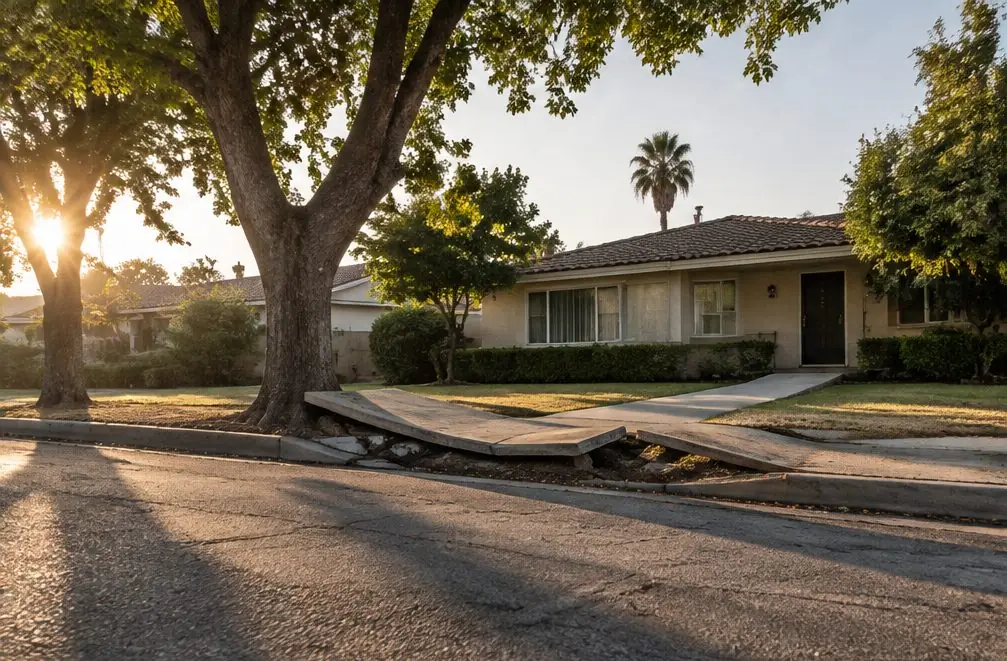
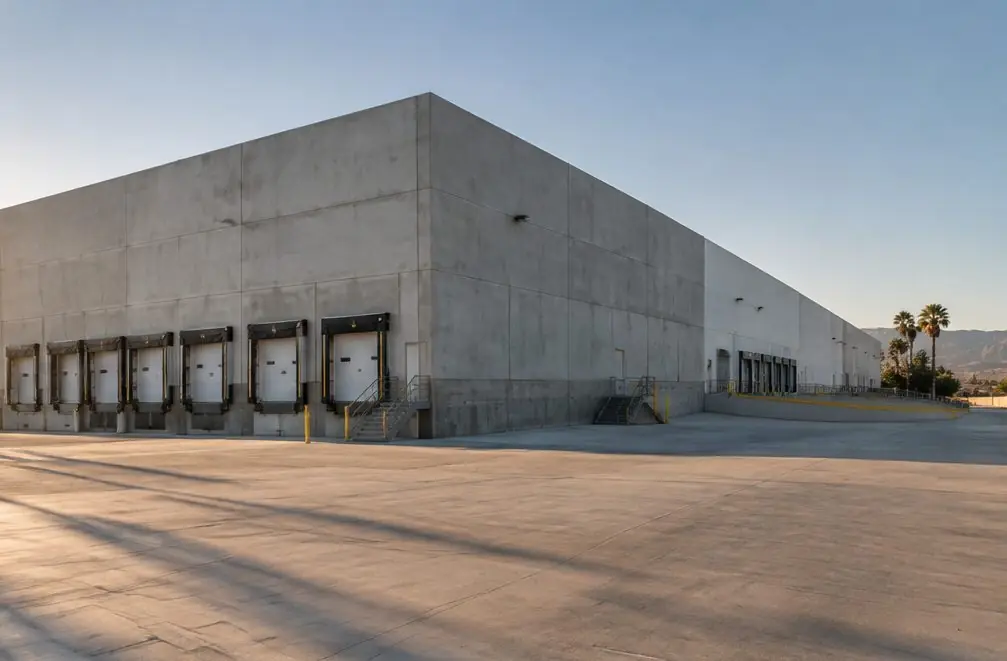
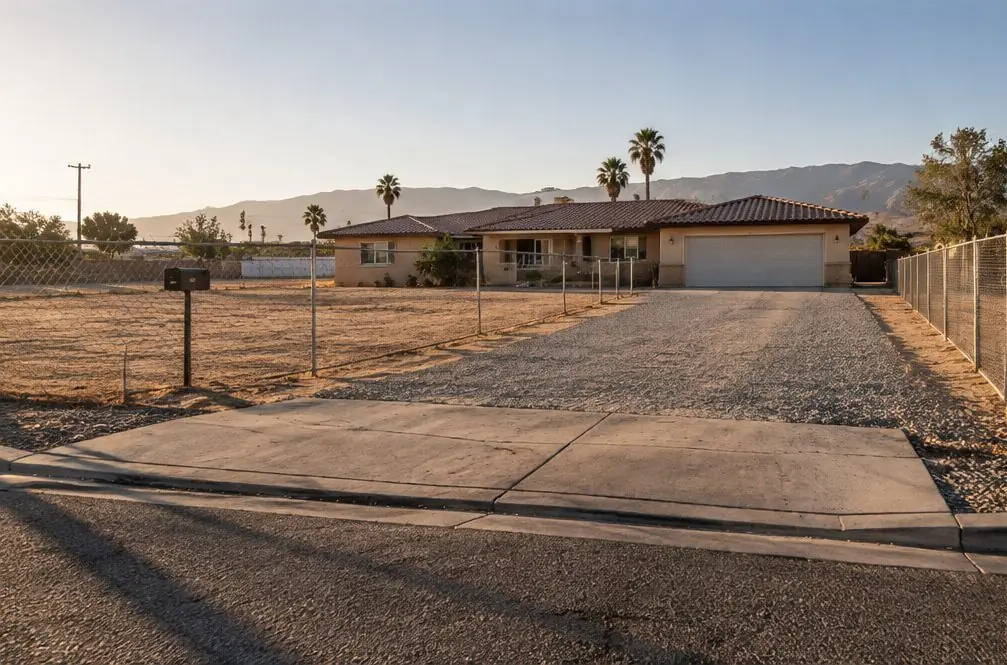
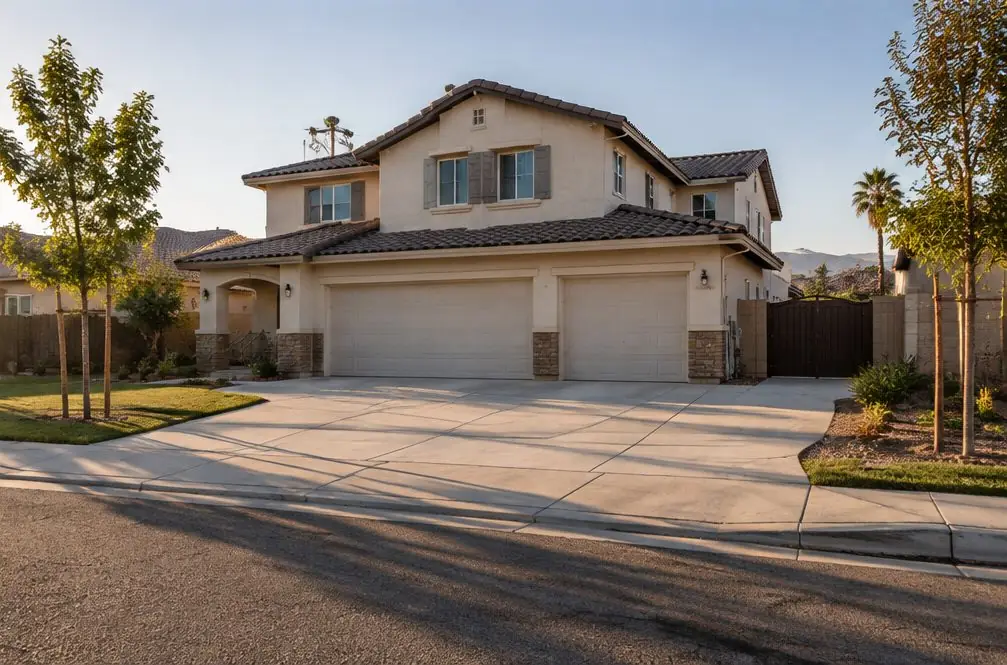
Typical Rialto area concrete prices, square foot by square foot
Pick the job, the size and the details, and see the range. No contact details needed. Bookings open here once a local concrete contractor is named on this site.
Bookings aren't open yet. Leave your name and number; your message is recorded, and you'll get one message when a local installer is available.